
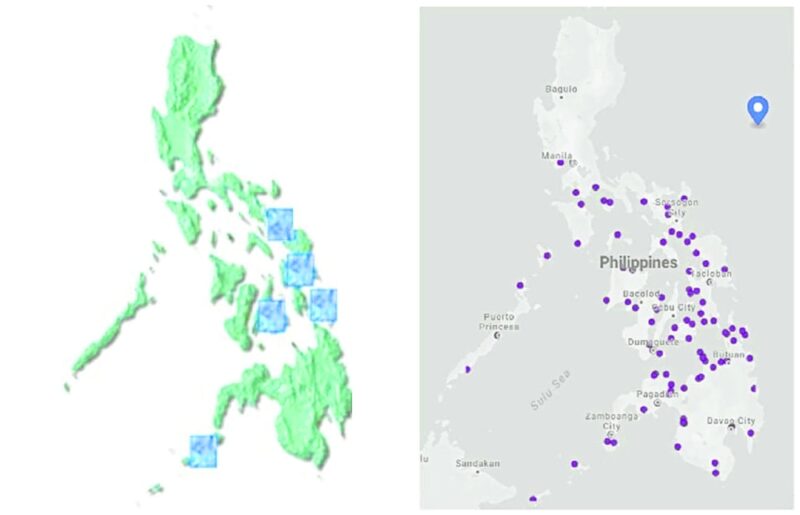
“According to independent studies, the Philippines’ coastal waters have a total theoretical potential power of as much as 170 gigawatts, compared to the country’s current installed capacity of 32 gigawatts,” explained Ricafort.
“Although not all of the ocean’s power is practically recoverable, harnessing even just 18 to 20 percent of the archipelago’s total tidal energy is theoretically sufficient to cover the Philippines’ current power consumption,” he added.
Gravitational pull
To do this, Ricafort and Recto are eyeing the use of submerged tidal-stream energy systems—mechanical generators that directly convert the constant movement of tides into electricity.
They identify the San Bernardino Strait, San Juanico Strait, and Cebu Strait as among the most viable sites for tidal-stream energy systems based on water current speeds, proximity to population centers, and access to electrical grids.
Near Capul Island in Northern Samar, a one-megawatt tidal-stream system is already being installed to replace diesel-powered generators supplying the remote community. The researchers say this could serve as a model for expanding marine renewable energy across the country.
A bidirectional tidal turbine system developed by Dutch company Tocardo harnesses the gravitational pull of the tides and waves to generate clean, predictable renewable energy. Several of these devices are currently being installed near Capul island in the San Bernardino Strait to replace the diesel generators that currently power the small island town.